Showing posts with label Sprout Social. Show all posts

Thursday, 12 November 2020

Video accessibility: How to add YouTube subtitles to your videos

When creating and sharing videos, you want to make sure your content can be consumed by as many people as possible. Whether they’re hard of hearing or simply in a setting where they can’t have their volume turned on, viewers should be able to enjoy your videos.

This is why adding subtitles to videos is such an important step when publishing your content on YouTube.

Keep reading to understand why you should incorporate this into your YouTube strategy and how to add subtitles to a video.

Why are YouTube subtitles important

There are many reasons why you should include video subtitles on your YouTube channel. The main reason being adding inclusivity to reach an even wider audience.

Below are a few of the biggest reasons that captioning videos is a good practice.

Improve video accessibility

Over 5% of the world’s population suffers from hearing loss, and they shouldn’t be excluded from consuming your video content. Social media accessibility in general is important to be aware of, in all use cases, not just video.

Adding closed captions to your YouTube videos makes you more inclusive. Whether they’re watching to learn more about your product, service or industry, adding closed captioning expands your audience.

Encourage further comprehension

Not everyone learns the same way. So while many people are satisfied watching and listening to a video, others prefer to have text that they can follow along.

Using closed captions are also a great way to assist ESL learners as well. This allows non-native English speakers to read captions while listening to videos, as they learn the language or keep up with those who are speaking too quickly.

However, even native learners still appreciate the ability to turn on subtitles as many people still enjoy watching TV with closed captions.

Boost SEO

YouTube and Google both index the subtitles and closed captioning text. This will help give search engines even more context about your video apart from keywords in your video title, description and tags. This helps to boost your YouTube SEO and potentially rank for even more keywords.

It can also strengthen your already optimized video even further for the focus keyword(s) you’re already targeting by including it within your closed captions. It needs to be noted though that closed captions can be indexed, not open captions. Since open captions are encoded within the video file, they cannot be indexed by search engines.

Improve the overall user experience

Many people don’t want to or aren’t in a position where they can watch your video with sound. In fact, 85% of Facebook videos are watched on mute.

By adding subtitles to your YouTube videos, you’re giving your audience the capability to browse your channel on mute without making a mental note – then later forgetting – to watch your video when they can turn sound on.

How to add YouTube subtitles to your video

We’ve covered a few reasons why you should add subtitles to your YouTube videos. Now let’s go over the how-to so that you can immediately start implementing this tactic.

Step #1: Log into your YouTube Studio

The first step is to head over to YouTube and log into your YouTube Studio dashboard. This should come as no surprise since this is your main dashboard for making any changes to your videos or viewing any sort of channel analytics.

Step #2: Click the Subtitles tab in the left sidebar navigation

Once in your YouTube dashboard, click the Subtitles tab in the left sidebar to access this feature on your YouTube video.
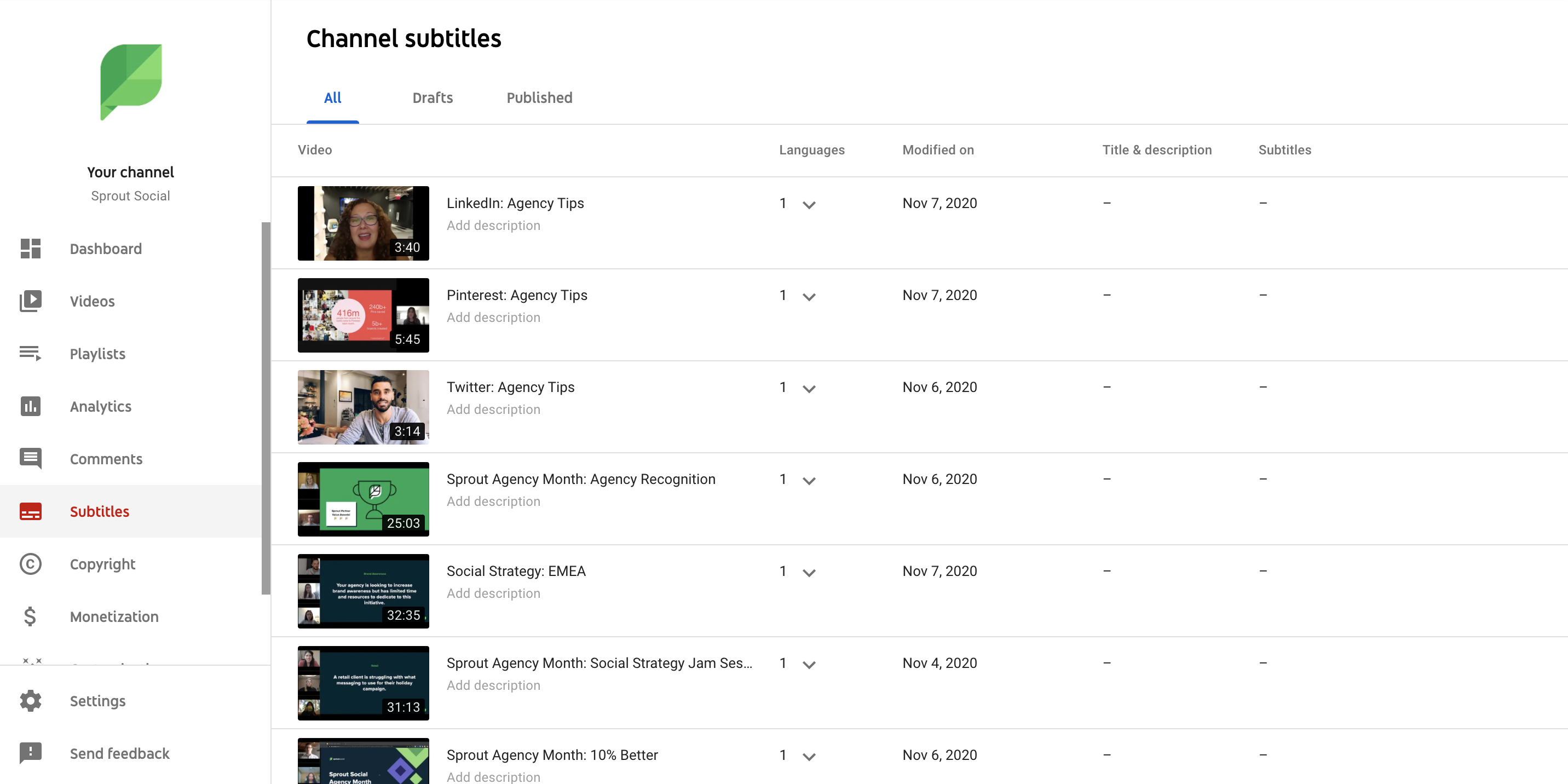
Screenshot of the YouTube Subtitles dashboard, showing all videos that can or have subtitles.

Step #3: Select the video you want to add subtitles to

Here, you’ll get a full view of all your uploaded videos. Once you find the video you want to update subtitles to, click on the pencil icon to edit it.

Step #4: Set your language

The first thing you need to do is set the default language for your video. While you might eventually add in subtitles in various languages, the default language should be based on the language mostly spoken in the video.

Step #5: Edit the subtitles on your video

Once you confirm your video’s language, you’ll be taken to a page that shows automated subtitles added in your language. Click the Duplicate and Edit button so you can correct any errors made in the automatically generated subtitles.

You’ll be taken to a new screen where you’ll be able to edit the auto-generated subtitles.
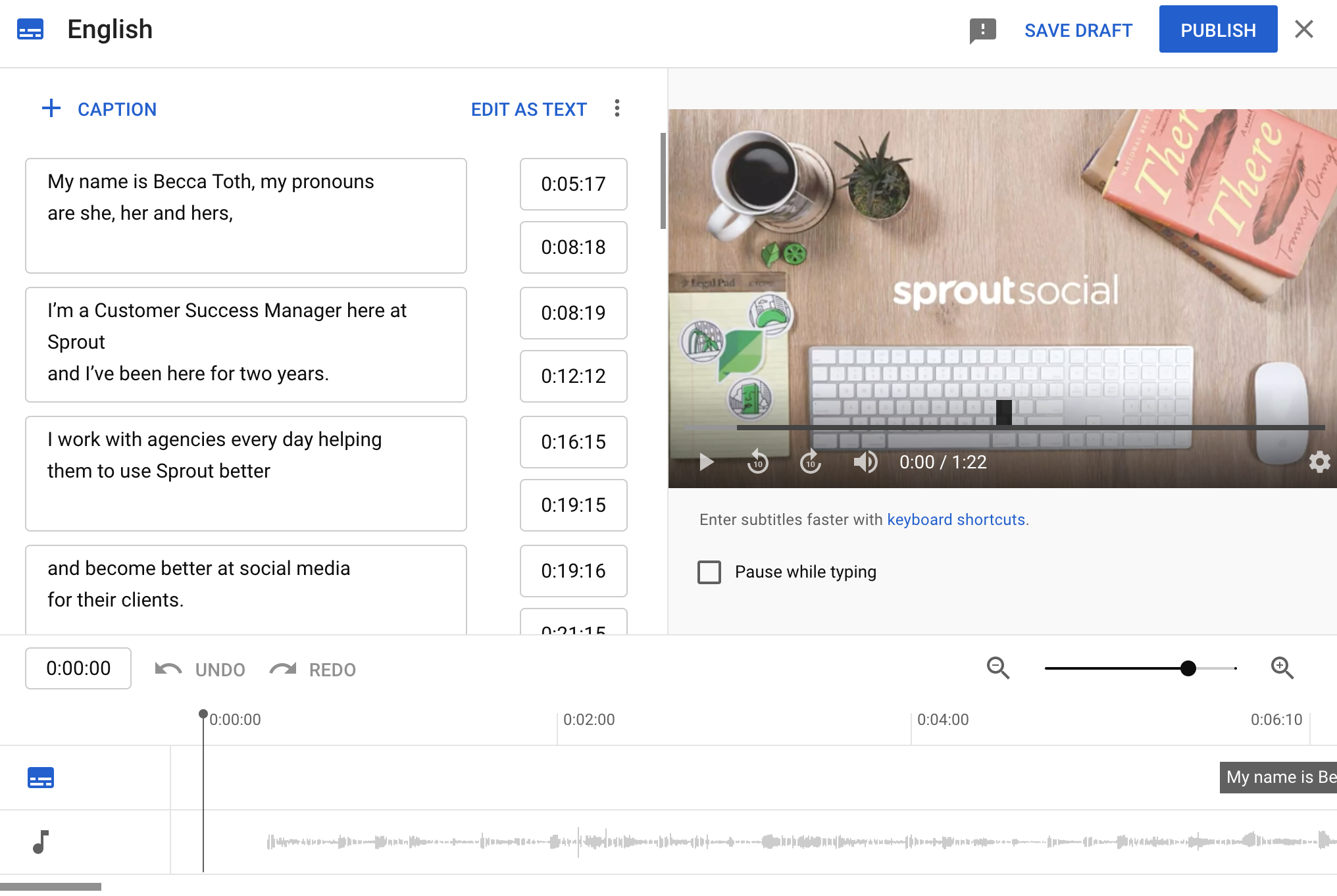
Screenshot of adding YouTube subtitles to videos.

While the auto-subtitles are a great starting point for you, they’re likely not accurate. So go in and add punctuation and adjust any inaccuracies you may notice. This would also be the time to adjust timestamps on your subtitles as well.
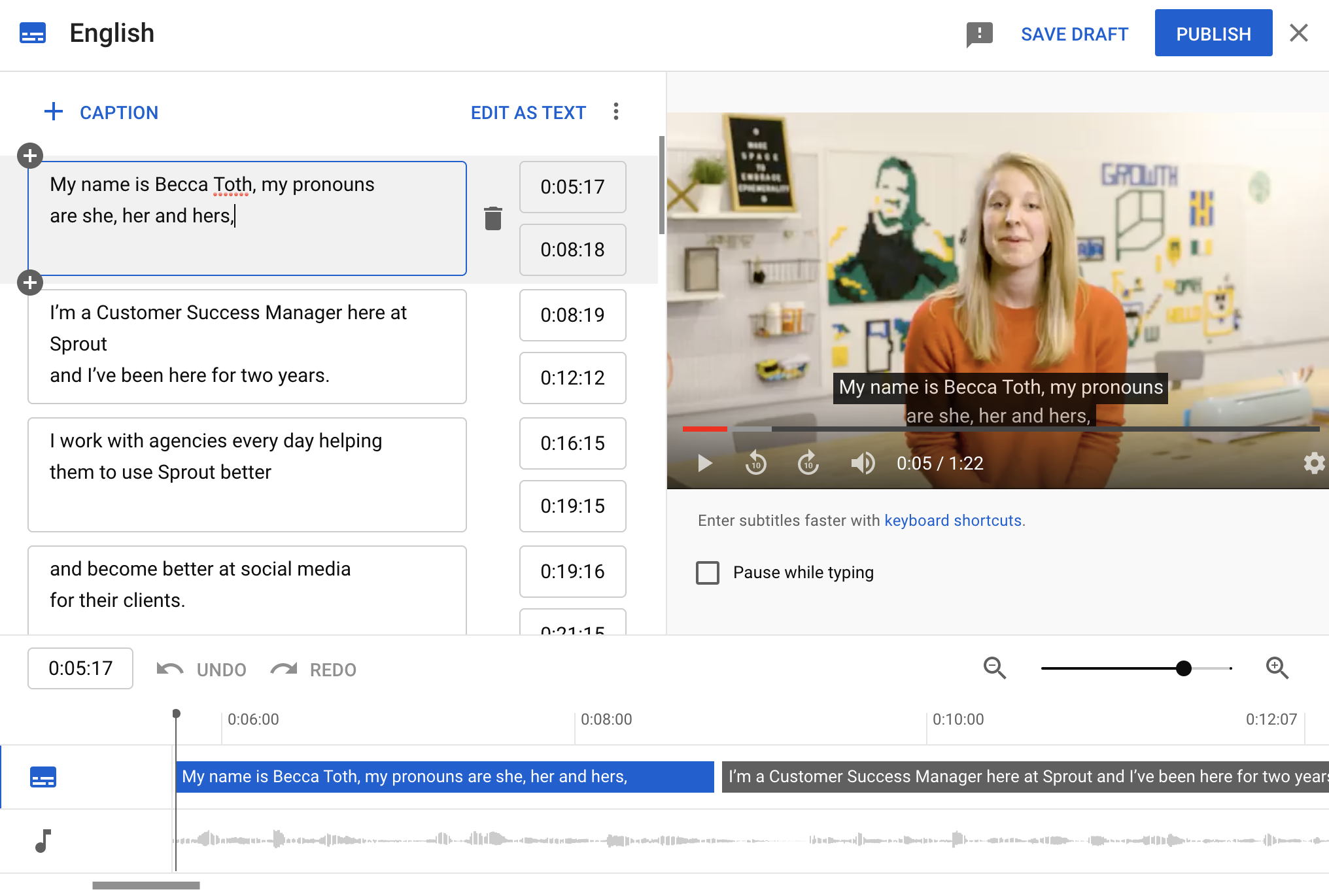
Screenshot of adding YouTube subtitles to videos and assign them to timestamps.

Step #6: Publish the subtitles

Once you’re satisfied with your subtitles, save and publish them, then go view your video to ensure they appear properly.

Head back to this section anytime you want to add additional languages to your video subtitles.

Tools for adding YouTube subtitles

If you’re looking for a faster way to transcribe your YouTube video to add subtitles – not that we blame you – there are a variety of tools you can use.

Below are some tools that can help you easily create and add subtitles to a video.

YouTube automated subtitles
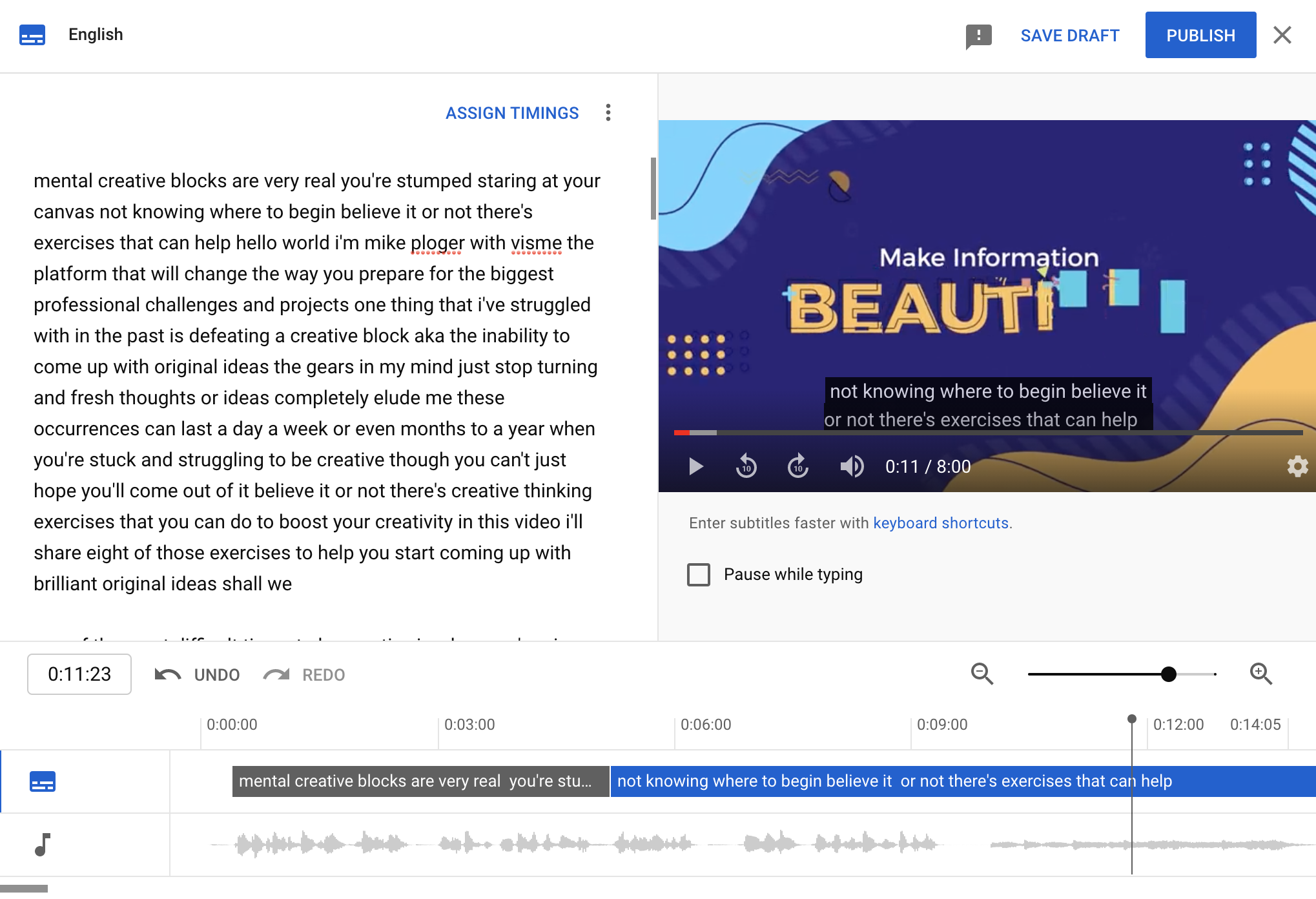
A screenshot of the YouTube subtitles editor

When you first add subtitles to your video, YouTube automatically publishes their automated subtitles that their tool captures from your video.

As mentioned before, these aren’t typically 100% accurate and often don’t include proper punctuation. But it can be the perfect, completely free option to help you get a jumpstart on captioning videos on a budget.

You can watch and pause the video alongside the caption box so that you can make any necessary corrections to your YouTube subtitles and immediately publish them so your viewers have access to them while watching your videos.

Rev
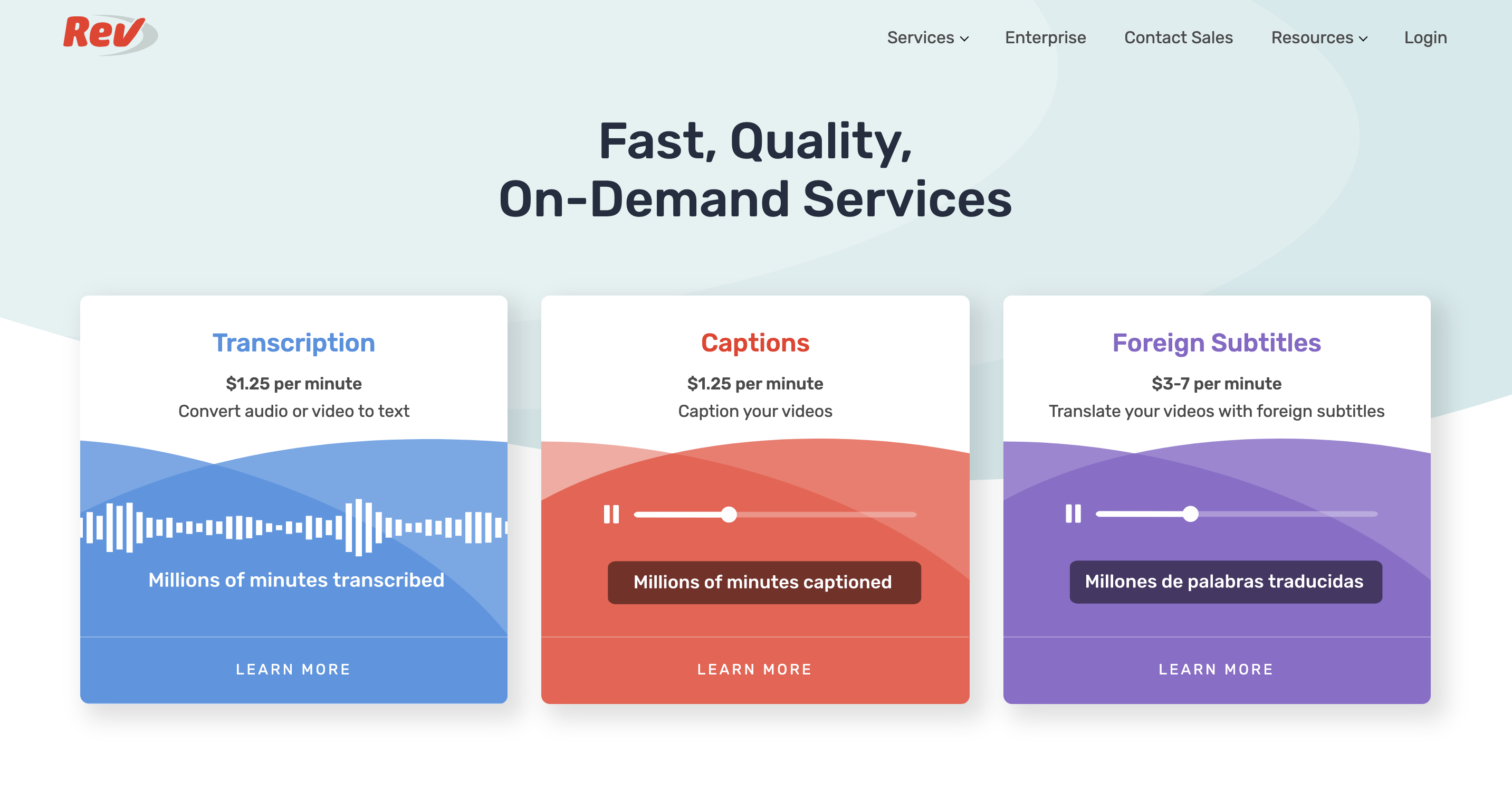
A screenshot of transcription company Rev's website home page.

Rev is a transcription company that offers a few different options for transcription for a fee. You can get captions written for your videos by human professionals with 99% accuracy for $1.25 per minute, or you can get a transcription on a budget and have their AI machine transcribe your content with 80% accuracy for $0.25 per minute.

With its different offerings, Rev is able to fit a variety of different budgets and make it easy to get closed captions for your YouTube videos. Once your transcriptions are complete, you can easily paste them into the subtitle editor on YouTube and publish them.

Otter.ai
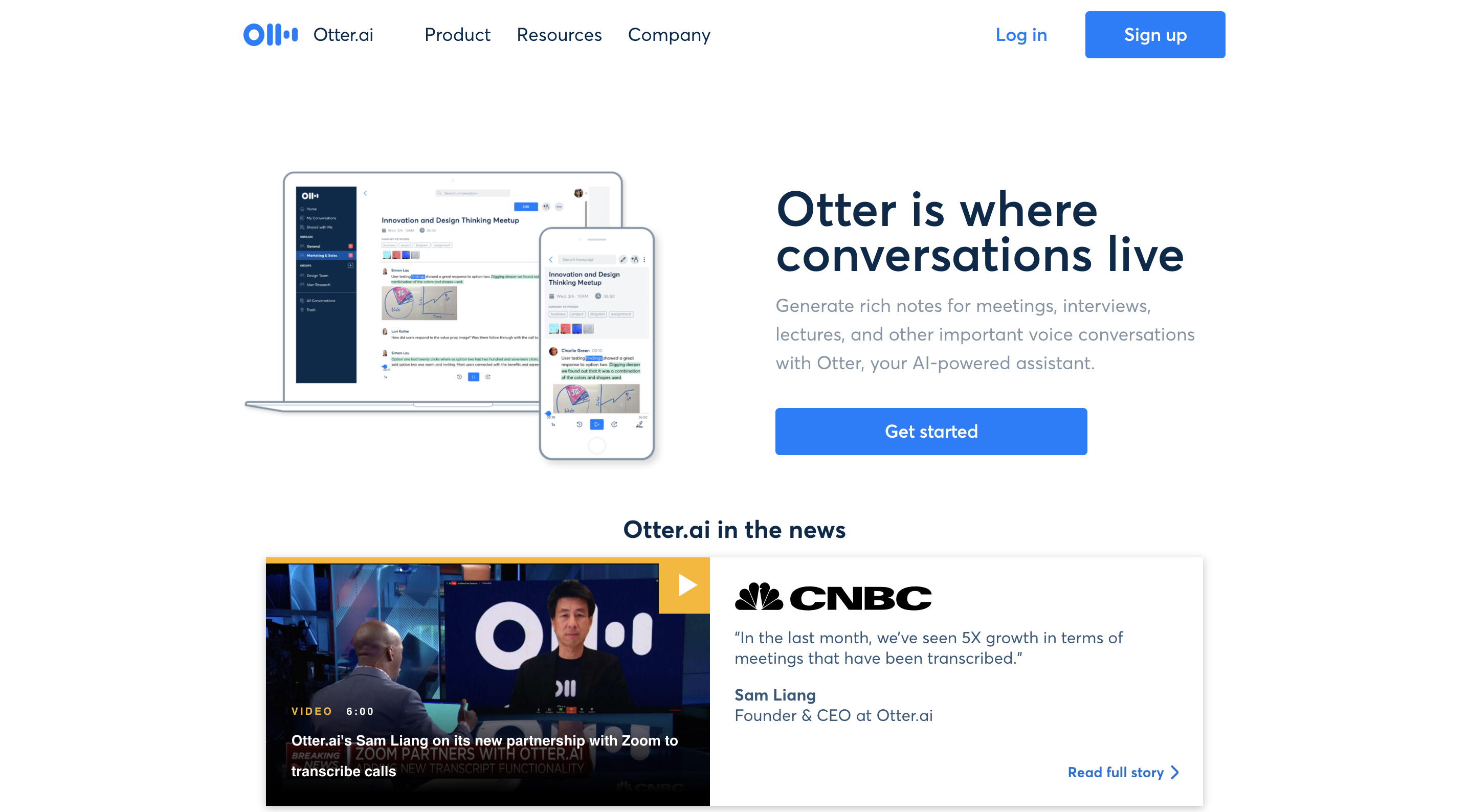
A screenshot of transcription software Otter.ai's website homepage.

Otter.ai is a transcription software that can be used for live transcriptions of meetings, video conferences as well as your YouTube videos to create highly accurate captions and meeting notes.

The AI-powered software allows for immediate, automated transcriptions of your meetings and videos at an affordable cost.

Otter.ai has a free plan with a limit of 600 minutes of transcription as well as premium plans starting at $12.99 per month so you can easily get started transcribing your YouTube videos and adding subtitles to each new video you publish.

Subly
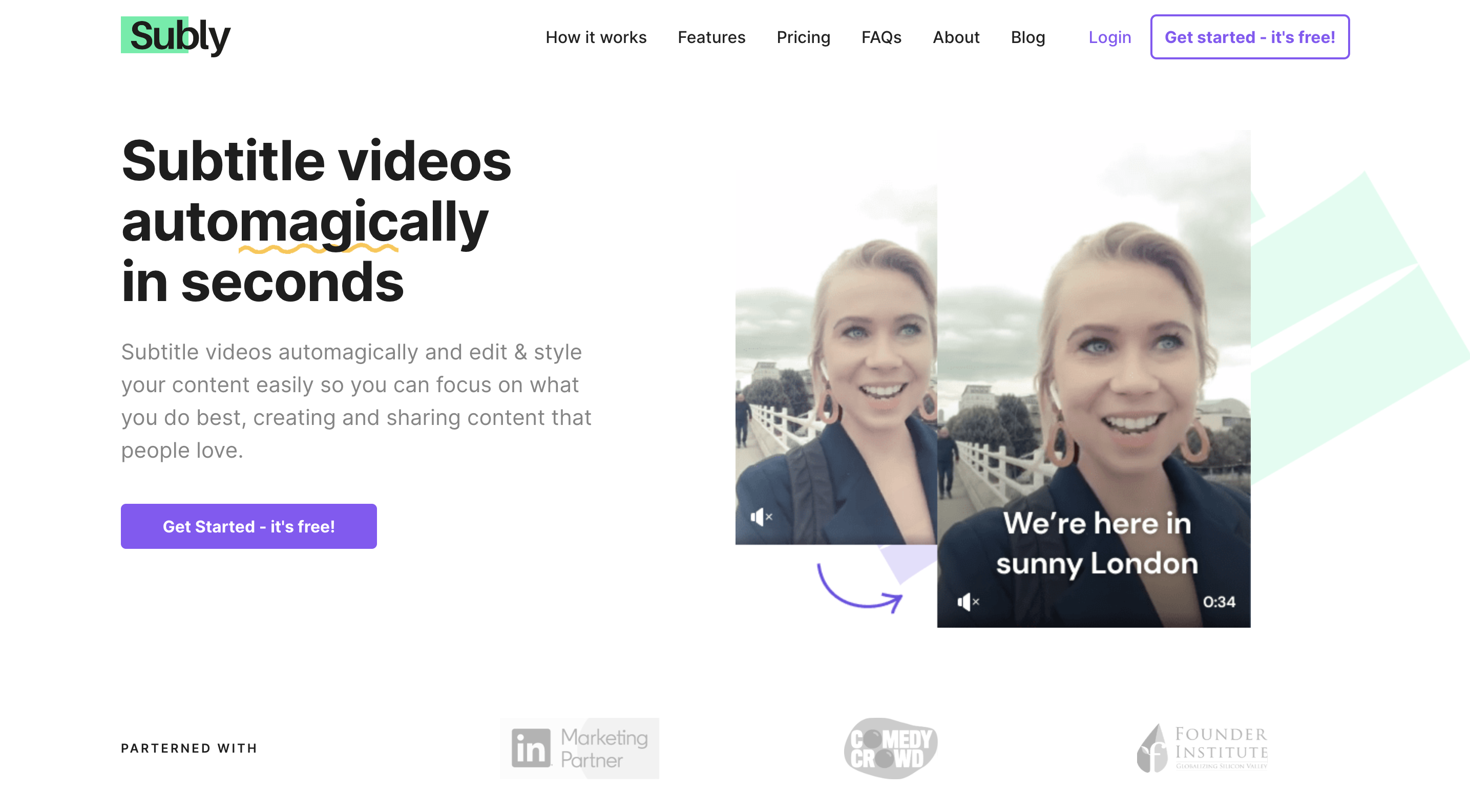
A screenshot of transcription software Subly's website homepage.

Our last tool recommendation to help you add captions to video online is Subly. This tool was created specifically for captioning videos for accessibility and user experience.

There are a couple different ways you can create subtitles for your videos. You can have the tool automatically overlay the captions on your video in your choice of font and font color, or you can download the caption text to add to a video editor.

While overlaying video subtitles can be perfect for platforms like Facebook or Instagram Stories, you want your YouTube subtitles to be readable by search engines. Therefore, you’ll want to export the text file so you can paste the captions into the subtitle text area on YouTube.

Subly comes with a free plan for up to 40 minutes of transcription, which is perfect for when you’re regularly creating and sharing shorter videos on YouTube. If you need more than 40 minutes, pro plans start at just $8/month for 100-1,000 minutes of transcription each month.

Start adding YouTube subtitles to your videos

Accessibility and user experience are important issues to take into consideration for all of your online content and for all audiences. To learn even more about making your social media content accessible and inclusive, read our post on online accessibility here.

This post Video accessibility: How to add YouTube subtitles to your videos originally appeared on Sprout Social.


from Sprout Social https://ift.tt/3eSTIyg
Do You Know You Can Buy Instagram Followers from SocialKingMaker.com?

Wednesday, 11 November 2020

How to write a white paper that inspires a year-long content strategy


When it comes to establishing one’s brand as an authority, few resources get the job done like a data-driven white paper.

Longer than your typical blog post and more in-depth than an ebook, a white paper is a well-researched piece of content designed to educate readers on a specific topic. It allows you to position your brand as an expert in your field and demonstrate you have a solution to your audience’s problems. And because marketers often gate white papers behind an email form, these reports can help support goals like lead generation and sales.

But with a little foresight, a white paper can do more than capture leads. It can also fuel an entire year’s worth of content and support teams across sales, customer success and even design. From developing social media content to webinars to workshops, there are a number of ways you can extend the life of your white paper.

In this article, we’ll walk you through how to write a white paper as well as how to turn those data and insights into new content for the entire year.

What makes a white paper valuable?

Traditionally, a white paper is defined as an informational document to promote a product or service and is used by marketing and sales to persuade buyers to purchase from one brand over another. In marketing, a white paper can be used to provide in-depth research on a particular subject (like the state of social marketing) and gives brands an opportunity to build credibility with their audience.

Consider this data-driven white paper example: the Sprout Social IndexTM. The IndexTM is our annual 30+ page white paper filled with unique data based on consumer and marketer surveys. We look specifically at the state of social marketing, and offer insights on topics like consumer behaviors, marketers’ social goals and what differentiates one brand’s social presence from a competitor.

It takes roughly three months and collaboration across marketing, design and sales for the IndexTM to come to life. On the other hand, this blog post you’re reading took me about one week to complete. To illustrate how to plan and develop a white paper with legs beyond its initial launch, we’ll share how we create the IndexTM and the various assets that come from our annual report.

Phase 1. Planning for success

Before diving into topic ideation, establish the goals and objectives you want to achieve with your white paper. Goals can include everything from raising brand awareness in your target audience to fueling new business acquisition by generating leads. And determine which key performance indicators (KPIs) you’ll use to track your progress toward your goals, like net new users and content downloads. From there, develop a project plan with clear expectations around responsibilities and due dates, like when to expect a first draft or design assets for social promotion.

Once your goals and project plan are in place, then you can focus on narrowing your white paper to one specific topic. When in doubt, start by identifying your audience and brainstorming the different problems you can help them solve.

For the Sprout Social IndexTM, we look at a couple of factors to inform our direction:

  • Our audience’s needs. Think about who is going to read your white paper and what problems they’re hoping to solve with the information provided. For the IndexTM, we know we’re speaking to social media marketers of all industries and experience levels, from solo practitioners to directors managing a team. So the data we offer needs to help our audience advance their careers, strengthen their strategies and sharpen their skill sets. We’ll consider things like top goals and challenges for social marketers, how social is viewed within an organization and what skills marketers hope to develop.
  • The state of the industry. In addition to specific audience needs, we also look at what’s happening within the industry at large. Are there emerging trends our audience wants to understand? How are other brands responding to industry changes and what can readers learn from these examples? To ensure the IndexTM is relevant for social marketers of all industries, we’ll look at big trends in the overall social marketing landscape like which platforms are most popular among consumers and what types of content generate the most engagement.

If you plan to use your white paper to inspire a year’s worth of content, take a moment to evaluate if the topic will be relevant a year from now. Timely data, while it can be extremely valuable as part of your content strategy, gives you less runway to develop content six, seven or eight months post launch. Additionally, you’ll need to have enough data to work with in the future. Keeping the topic broad enough will enable you to drill down into specific angles for future content.

Phase 2. Writing a white paper from start to finish

With a plan in place, it’s time to conduct your research, develop your white paper structure and deploy any surveys for data collection.

With the IndexTM, we use a platform like SurveyMonkey to conduct two different surveys: one for 1,000 consumers and one for 1,000 social marketers. We ask consumers questions like which social platforms they use the most and what actions can turn them off to a brand’s social presence. In the marketer survey, we ask them how they use social data, what their greatest challenges are and what factors influence their approach to social.

If you’re unsure how to analyze the data, try creating a separate Google Doc or spreadsheet to house your key findings, organized by question number. When reviewing the IndexTM data, we look at things like:

  • Responses to all questions without any filtering or comparisons
  • Results when we narrow our focus to one particular subgroup (e.g. marketers at companies with only 1-50 employees)
  • Responses that contradict our original hypothesis
  • Contrasts between the two audiences (e.g. marketers versus consumers)

Remember: you won’t use every single data point in your actual report. Instead of tossing unused data to the side, consider using that information as inspiration for a future piece of content.

With your data in hand, it’s time to put pen to paper. Writing a white paper can take several days, or even weeks, and it’s helpful to start with a comprehensive outline to plan out the report flow. In the outline for the IndexTM, we include examples of the quantitative data to highlight and brand examples discovered during the research stage. Allocate about one week for outlining and drafting, which should include chart mockups of the data you plan to use.

For reviews, ask for feedback from your key stakeholders, including those who don’t work in content directly. IndexTM feedback from our social team ensures we’re giving our target audience what they need while our PR team can recommend future storylines inspired by the report.

Phase 3. Bringing the data to life with creative

Another facet that distinguishes a white paper from a blog post is that white papers are often packaged as a designed PDF.

In addition to creating the PDF version of the IndexTM, our design team creates graphic assets and charts for use in content, on social and beyond. One of the reasons we ask our social team to review the final draft of the IndexTM is to get feedback on which stats and insights will make for compelling graphics on social.

For example, one of the charts included in the IndexTM talks about how consumers find new accounts to like and follow on social.

Using the feedback from social, we identified one standout data point from this graph, and the design team turned it into a separate social graphic.

Developing a unique design system and color palette for each white paper creates a consistent visual identity so every asset looks like it belongs to the IndexTM campaign. This also gives designers the flexibility to create new assets like GIFs throughout the entire year because they have a wide range of colors and motifs to pull from.

With your report ready to launch, remember you still need to track your progress toward your goals. Tracking not only shows you if you’ve achieved your goals but also if you need to adjust your distribution strategy to make up for lost ground.

Phase 4. Giving your white paper longevity

So you’ve officially published the final white paper PDF and all of your design assets—congratulations! But just because you hit that publish button doesn’t mean the work behind the scenes suddenly stops.

To kick off the IndexTM, we publish different teaser posts for two different audiences: one for the social media manager and one for an executive. Both articles preview some of the salient data points and highlight how the report will address marketers’ challenges, ultimately encouraging readers to download the IndexTM

To keep that momentum going, our social and creative teams collaborated to create the #DataDance, a series of short dance moves inspired by findings from the IndexTM. We encouraged our followers to both learn and share their own #DataDance with us on social.

We also created new content like webinars and articles with industry-specific benchmarks months after the publish date. We also repackaged the IndexTM as part of a larger toolkit for marketers as they begin planning for 2021. Finally, we included data from the report in our Data in Action workshop for social marketers, five months after the IndexTM launched.

When you can repurpose the data and insights from your white paper, you stand to reach new audiences, reinforce your original argument and demonstrate your expertise in a particular topic.

Breathe new life into your white paper

White papers are not only a great resource for brands to establish their expertise and build authority with their audience, they also can inspire entirely new pieces of content post launch. By repurposing your report and turning it into new content, you can extend the longevity of your data and ensure your white paper continues to drive traffic for the entire year.

Looking for more inspiration for your content strategy? Check out what marketers and consumers say makes a brand’s social best in class and other content insights in the Sprout Social IndexTM today.

This post How to write a white paper that inspires a year-long content strategy originally appeared on Sprout Social.


from Sprout Social https://ift.tt/2IuX5j0
Do You Know You Can Buy Instagram Followers from SocialKingMaker.com?

Tuesday, 10 November 2020

10 clever ways to improve your Glassdoor presence using Sprout Social

Day in and day out, people are making choices about what to eat, where to shop, what to watch and so much more. When the answers aren’t immediately obvious, we frequently turn to others for guidance. Fortunately, in the digital world, a simple internet search surfaces consumer reviews about nearly anything, which help shape our decisions and impressions of businesses and brands.

Glassdoor houses over 70 million reviews and insights on over one million companies, helping people make one of the most important decisions we can make for ourselves: where to work.

Given that 86% of job seekers are likely to research Glassdoor company reviews and ratings before applying, it’s critical for businesses to engage with that community and actively put their best employer brand forward. Sprout Social helps power that effort with our Glassdoor integration. It’s baked into our Reviews tool so social media managers, human resources and business leaders can unify their employer branding efforts with ease.

Check out these 10 clever ways to leverage the integration, improve your Glassdoor presence and create a better place to work.

1. Regularly monitor Glassdoor company reviews

You wouldn’t let your other social media platforms go unmonitored and unchecked, and Glassdoor should be no different.

Reading Glassdoor reviews is mutually beneficial for both job seekers and companies. The former group gets the inside scoop through first-hand employee experiences. The latter gets honest, constructive insights that they can use to further shape their employer branding strategy. Once brands connect their Glassdoor profiles in Sprout, they can evaluate their ratings and reviews with ease and collect feedback alongside other business reviews from Google My Business, TripAdvisor, Facebook Reviews.

Glassdoor Reviews in Sprout

2. Quickly respond to employee reviews

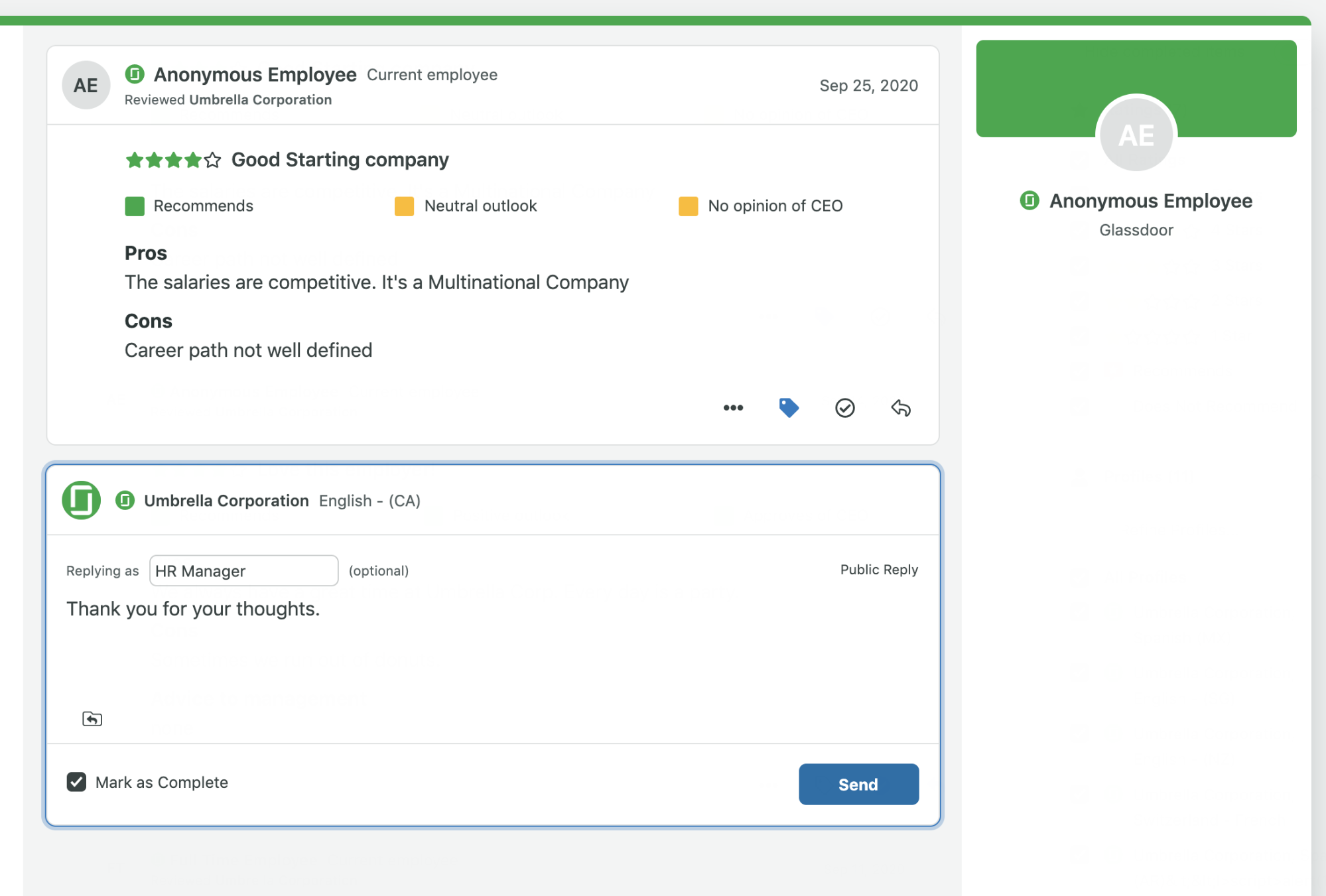
It’s not enough to just read your brand’s reviews. You need to respond to them too. When Glassdoor users see that an employer responds to reviews, 80% of them agree that it improves their perception of that company. Additionally, they’re more likely to apply to an open job if the employer is active on Glassdoor.

As Glassdoor’s Lead Product Marketing Manager Sophia Fox says, “The conversation that is shaping your employer brand perception is happening on Glassdoor with or without you, so you might as well join it.” When your brand responds to reviews, both negative and positive, you actively demonstrate that you are engaged, listening and invested in being transparent about what it’s like to work at your company. When reviews are critical, responding gives your company a chance to address how you will correct issues, clarify any misunderstandings and amplify the positives.

Similar to Sprout’s Smart Inbox capabilities, our Glassdoor integration streamlines engagement and powers quicker response times, which people have come to expect.

image7.png

3. Embrace constructive feedback

Glassdoor reviews are paired with star ratings which act as a sort of grading system. The average of those ratings is prominently displayed in the reviews tab, giving users an immediate impression before they even start reading further.

Improving that rating comes down to understanding and reacting to the good, the bad and the ugly. Within Sprout, users can filter reviews by star ratings to see trends in both negative and positive reviews.

While it might be tempting to just revel in the five-star reviews, it’s equally important to dig into areas for improvement. Yes, people often express their experiences on Glassdoor to inform and help job seekers or support their company, but also consider that sometimes, the platform is an outlet where employees feel more comfortable expressing frustrations because they can remain anonymous. Hone in on one to two-star ratings, embrace the feedback and use those insights to create a path for change.

4. Tag reviews to track key topics and themes

As reviews come through on Sprout, users can apply tags that relate to particular topics to each message. Let’s say you’ve recently changed your work from home policy. As Glassdoor users leave reviews relating to that, add a tag. Then, use Sprout’s Tag Report to evaluate those review trends and gauge the overall sentiment around your offerings. Users can also export the Tag Report so they can share the results with leaders and other teammates with a stake in employer branding.

Screen Recording 2020-11-06 at 01.40.20 PM.gif

If you want to cut through the noise and get straight to the topics you care most about, you can also use the inbox search functionality in Sprout to find specific messages. As you search, consider that people may use different spellings or variations to describe something like “work from home,” such as, “remote work,” “WFH,” and more. Applying tags to messages that use those kinds of variations will help keep those reviews organized.

5. Save the dates

Occurrences like COVID-19, layoffs or newly announced benefits might spark a flurry of incoming reviews. In those circumstances, Sprout users can filter reviews by dates and do an A/B test of sorts.

For example, let’s say your company switched insurance providers. You could compare reviews before and after the change, monitor the changes in sentiment and further refine your plans based on the feedback you receive.

6. Share feedback across departments

Glassdoor provides reviewers a level of anonymity so they feel freer to be candid, but many users do choose to display their role. In that case, you may want to apply a tag indicating the employee’s department so that you can later share feedback with managers, especially if the review includes complaints or compliments on department processes, leadership and internal changes.

Many Glassdoor users might want or expect HR representatives to be the ones to address their review, but company leaders and managers may be the better choice in some cases. As you respond to Glassdoor reviews in Sprout, you can choose who you want to attribute as the author. This will give the reviewer more confidence that they are being heard by people who they work with directly and make decisions on behalf of their team.

7. Act with urgency

Our jobs are our livelihood, so it’s understandable that if things go awry for an employee, they may use Glassdoor to express those feelings and frustrations. Those reviews aren’t necessarily a good look for a company but brands cannot delete reviews on Glassdoor unless they violate community guidelines. This protects transparency and the integrity of the platform.

The sensitive and potentially damaging nature of these kinds of reviews may require additional input and oversight from leadership, HR and/or your legal department. Fortunately, Sprout users can email these types of reviews directly to the necessary people within the app. Each email message also brings in additional metadata with the review so they get the full story.

Screen Recording 2020-11-06 at 01.51.38 PM.gif

8. Store responses in the asset library

As you uncover recurring topics, experiences or call-outs on Glassdoor, it’s helpful to build out a library of responses, similar to how you might for FAQs. Social media marketers have tons of experience responding and engaging with online communities, company managers know their teams inside and out and human resources professionals have a wealth of knowledge on hiring, benefits, policies and more. Together, they can build a powerful response strategy.

Sprout users can then store those approved responses in the Asset Library so that anyone who’s responding can easily use them as a template. This strategy will help keep brand voice intact. Keep in mind that best practice is to use these responses as jumping-off points and then customize from there, especially if a Glassdoor user provides an in-depth review.

9. Drive workplace transparency and equity for underrepresented groups

One thing that we all crave is a sense of belonging and acceptance. When we feel that at work, we produce better work. More than 76% of employees and job seekers agree that a diverse workforce is an important factor when evaluating companies and job offers. Unfortunately though, underrepresented groups still experience inequity and bias in the workplace.

To help people better understand the current state of diversity equity, and inclusion at a company, Glassdoor has introduced three new product features, including a diversity and inclusion rating, diversity FAQs and the option for reviewers to provide demographic information.

“We have a responsibility as a platform and employer to bridge the information gap that’s blocking the path to equity in and out of the workplace. By increasing transparency around diversity and inclusion within companies, we can help create more equitable companies and more equitable society, too,” said Glassdoor Chief Executive Officer Christian Sutherland-Wong.

Pay special attention to the reviews that highlight your company’s diversity and inclusion efforts or shortcomings, and use responses as an opportunity to articulate your commitment or plans for the future.

10. Use key insights from reviews to develop content centered around employer brand

The insights your company gains from monitoring, organizing and reporting on Glassdoor reviews should be actively applied to your employer branding strategy. Use the “pros” in reviews to reinforce your strategy and inspire new employer brand content.

If your rating is skewing toward the lower end of the scale, hone in on the “cons” in reviews to determine where you need to improve. Then, consider using the common themes to develop an internal survey to investigate further and gain a more holistic understanding of how your employees perceive company culture.

Get your foot in the (Glass)door

Glassdoor is more than a review site. It’s also a branding platform, a resource for job seekers and an opportunity for businesses to create a better, more transparent company culture. Help your company become one of the best places to work. Get started with a Sprout demo today!


This post 10 clever ways to improve your Glassdoor presence using Sprout Social originally appeared on Sprout Social.


from Sprout Social https://ift.tt/2JK123F
Do You Know You Can Buy Instagram Followers from SocialKingMaker.com?

Monday, 9 November 2020

Branded keywords: Why they matter and how to track them

Chances are you’re familiar with the concept of monitoring keywords.

From ranking in search results to figuring out how customers found out about you, keywords often represent a treasure trove of marketing data.

However, there’s a particular type of keyword that often gets overlooked.

That is, branded keywords.

Although they’re often treated as an afterthought versus @mentions and #hashtags, monitoring branded keyword conversations should be a top priority for companies today.

In this guide, we’ll break down what branded keywords are, why you need to track them and the best way to do so.

What are branded keywords, anyway?

Branded keywords are phrases directly associated with your brand, products and services. These types of keywords are discoverable through both social media and search engines.

Here’s a rundown of some of the most common types of branded keywords you’ll see in the wild.

Brand names

No surprises here. The most common types of branded keywords are literal brand names, such as:

  • “Sprout Social”
  • “Google”
  • “Patagonia”

Mind the distinction between branded keywords, #hashtags and @mentions.

For example, someone mentioning “Sprout Social” in a tweet represents the former, while someone tagging the @SproutSocial account or using the #SproutSocial hashtag would represent the latter.

Product names (or product lines)

Here we’re talking about mentions of specific products or product lines tied to a particular brand (think: “McRib”):

  • “Impossible Burger”
  • “Frappuccino”
  • “Pixel 4a”

And in some cases, product-related keywords might also be coupled with the brand it’s produced by (“Amazon Alexa,” for example):

  • “Echo Dot”
  • “Google Pixel”
  • “Apple Watch”

Brand misspellings or name variations

Whether due to typos, misremembering unique brand spellings or the Mandela Effect, many branded keywords worth tracking are actually misrepresentations of the brands that they’re referencing.

For example, the term “Hydroflask” might refer to the actual Hydro Flask (@HydroFlask) brand or similar types of water bottles. Some other examples might include:

  • “Camelpak” or “camel pack” (for @CamelBak)
  • “Northface” (for “The North Face,” @TheNorthFace)
  • “Tim Horton’s” (for @TimHortons, which cannot include an apostrophe due to character limitations)
  • “Fruit Loops” (for “@FrootLoops)

Also, consider common typos such as extra spaces and swapped vowels which could impact a branded phrase (think: “Sprout  Social” or “Spruot Social”). If you’re getting overwhelmed by the possibilities when it comes to these potential variations, keyword research can confirm the most common ones that people use to find your brand online.

Why branded keywords matter (and why you should track them)

Keeping track of your @mentions is a no-brainer.

Meanwhile, most brands obsess over their SEO performance and appearance in Google Search.

So why do branded keywords fly under the radar?

Food for thought: unlike @mentions or #hashtags, branded keywords on social media do not trigger notifications. This means that many brands are totally oblivious to these non-tagged interactions unless they’re name-searching themselves.

As for branded search via Google, such keywords are often of less interest to search marketers who rightfully want to rank for terms beyond their business’ name.

That said, let’s look at some key reasons why branded keywords deserve your undivided attention via social.

More opportunities for meaningful customer interactions and support

It’s no secret that people overwhelmingly use social media as a support channel.

However, not everyone that mentions you via social is necessarily going to tag you with a concern or compliment.

Perhaps they’re venting. Maybe they’ve tagged the wrong brand or simplify forgot to tag you at all.

Either way, having a pulse on your branded keywords means that you’ll never miss opportunities to interact with customers.

More comprehensive competitive analysis

Brand-related phrases are an underrated tool to not only spy on your competitors but also see how your reputation stacks up to others in your space.

Again, not everyone on social media is going to tag you. Conversations happen organically and unfiltered. That’s actually the beauty of social media: you can see the authentic thoughts of your target audience.

By keeping an eye on branded keywords for both yourself and your competitors, you can hone in these off-the-cuff conversations with ease.

Beyond social media, brand-specific keywords can help you better understand the search presence and ad strategies of your competitors.

For example, searching branded keywords related to researching a product can help highlight search ads that your competitors are running. These might include terms such as:

  • [brand name] alternatives
  • [brand name] competitors
  • [brand name] reviews

Plus, these searches let you take a peek at how your competitors stack up when it comes to shout-outs from industry blogs or news outlets.

slack alternative list

A better understanding of customer sentiment

Share of voice and customer sentiment are two of the most important social media metrics to track.

Share of voice represents how much people are talking about you versus your competitors or competing products. Meanwhile, customer sentiment is the measure of positive versus negative comments from your followers.

Again, branded keywords help highlight shout-outs, compliments and criticism that you otherwise might not see. The more mentions you’re able to monitor, the more holistic view you have of your social presence.

How to track branded keywords (the old-fashioned way)

Tracking brand keywords means looking at more than your notifications.

Monitoring such phrases is a cinch if you’re using a tool such as Sprout Social’s listening suite.

But before we get into that, let’s look at two older-school strategies that work.

Tracking via Google

If you’re primarily concerned with branded keywords in search engines, Google has a couple of tools to help.

For example, you can set up notifications in Google Alerts to inform you of brand mentions in blogs and other online discussions. This is more efficient than just Googling your brand name all the time. Google alerts make it easy to track branded keywords via search

You can also monitor your Google Analytics or other SEO tools to see how many branded queries are leading customers to your website. Additionally, you can see whether competing branded keywords are driving traffic as well.

Tracking via Twitter

Twitter is arguably the best platform to track branded keywords on social media.

Not only is it a popular and accessible channel for customer service but Twitter’s advanced search makes the process much easier.

Through advanced search, you can punch in multiple keywords of interest as well as exact-match variants of them. The fact that you can search for multiple terms at once is a time-saver.

Twitter advanced search is a good way to find branded keywords on social media

Unfortunately, trying to find branded keywords on Facebook or LinkedIn is somewhat of a slog. Doing so is pretty much impossible on Instagram considering the platform only allows you to search hashtags.

Of course, you can overcome all of these hurdles by using a tool like Spout.

Speaking of which…

The best way to track branded keywords (with Sprout!)

Let’s say you have your list of keywords and phrases in mind.

With Sprout Social, you can search for branded keywords across multiple social channels and monitor mentions within a single platform.

Using our Query Builder, you can put together your list of exact match or variant phrases to watch. It’s easy to add and remove terms accordingly.

sprout social query builder

Once you start tracking your keywords, you can then populate them in your social media reporting. For example, you can track your #hashtag campaigns and branded keywords at the same time. This is a great fit for tracking the performance of specific product mentions alongside a campaign that promotes those items.

branded keywords in sprout

Below is what the results look like in Sprout’s Smart Inbox. An added bonus is that you can reply directly to queries and comments without having to leave Sprout. For example, you can respond to a customer question on Instagram while thanking someone for a shout-out on Twitter side-by-side.

sprout smart inbox twitter

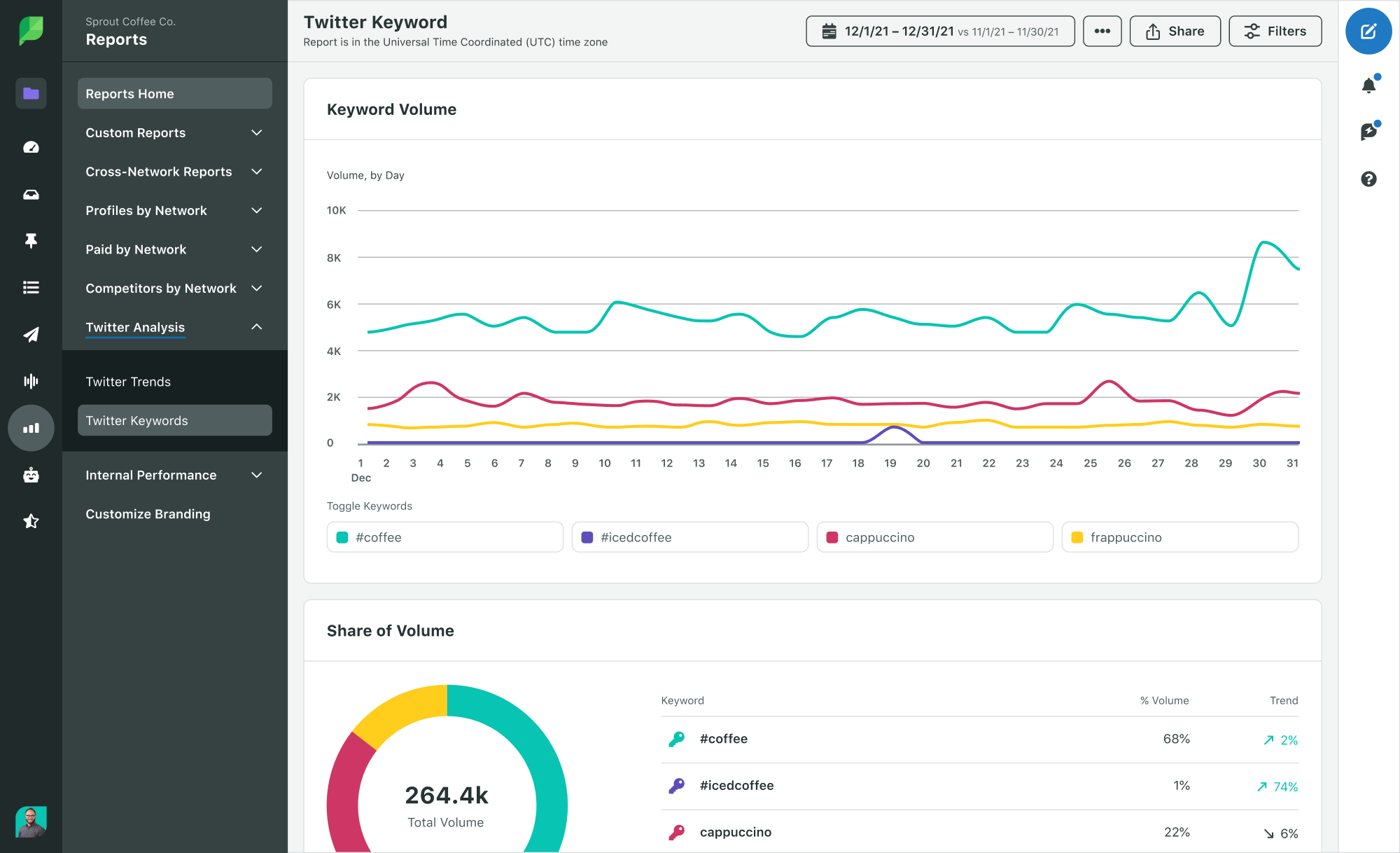
In addition to mentions, Sprout allows you to create reports based on your keywords’ performance. If you’re interested in seeing how many non-tagged mentions your brand gets, you can monitor it just like any other social media (see the “Twitter Snapshot”) below.

sprout social listening topic builder


What else can I do with my branded keyword data?

To wrap things up, we’ll break down how you can translate your keyword into action and inform future marketing decisions.

Highlight your share of voice versus your competitors

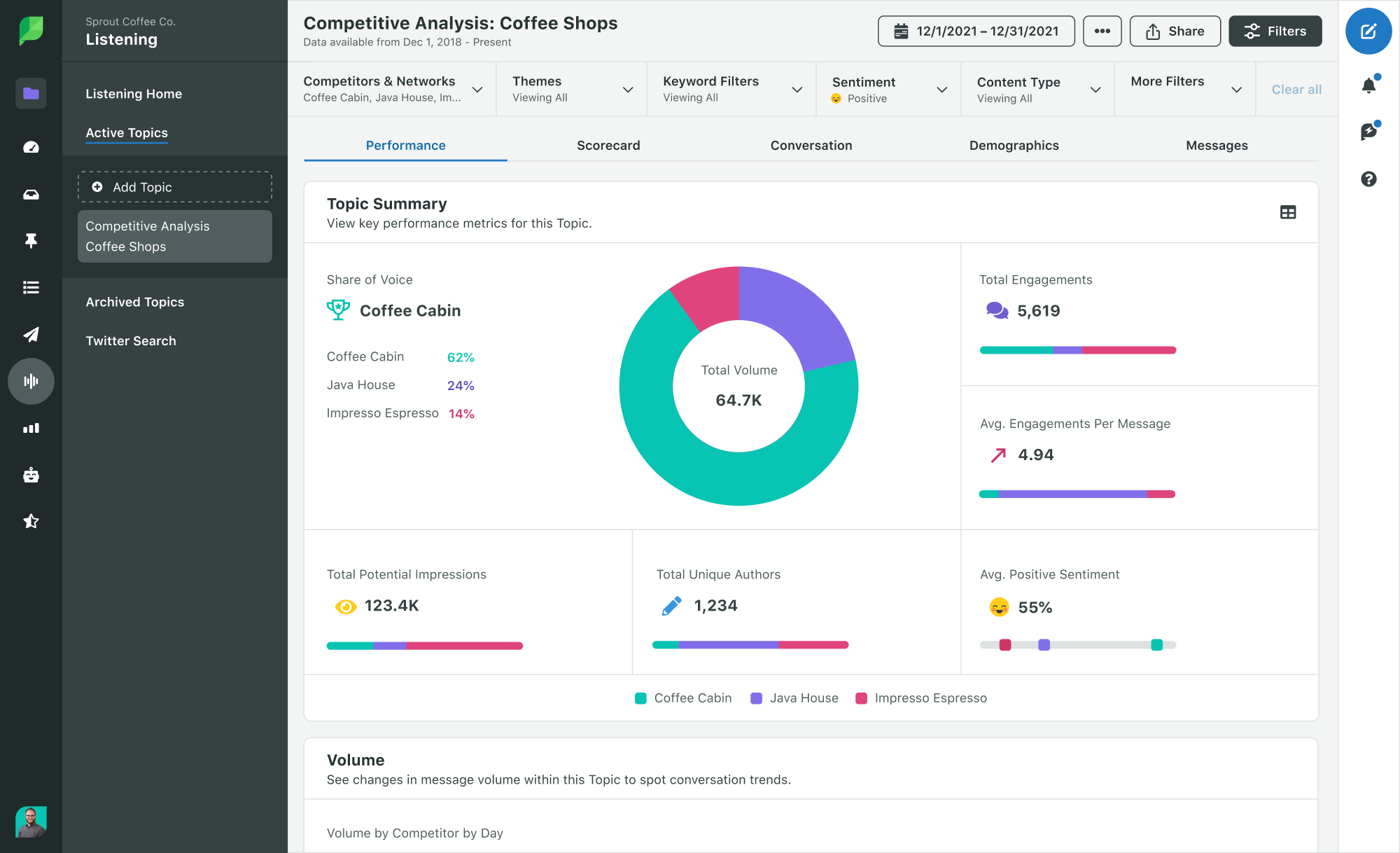
Sprout’s listening report represents a comprehensive competitive analysis that highlights the following metrics in one place:

  • Share of voice (your competitors’ mentions versus your own)
  • Total engagements and average engagements per message
  • Total impressions
  • Average positive sentiment
share of voice report

Based on these numbers, you can determine your own reach versus your competitors. You can likewise see whether or not customers see you in a more positive light over time.

Uncover more conversations with customers

So much of tracking branded keywords is about uncovering opportunities to talk to your customers.

Because Sprout tracks hashtags and branded keywords in one place, you never have to worry about missing a conversation or jumping between reports. With our reporting, you have a more holistic view of your customer interactions.

sprout twitter report with branded keywords

This report can highlight which keywords are driving the most conversations and how well your brand is doing when it comes to encouraging interactions.

And with that, we wrap up our guide!

Are you making the most of your branded keywords and mentions?

If you want the most comprehensive view of your customer interactions and reputation possible, tracking branded keywords is an absolute must-do.

Our suite of listening and monitoring tools simplify the process. Setting up keyword tracking and reporting is simple for beginners and can be done in no time flat.

Want to see for yourself? Take a test-drive of all the awesome monitoring features baked in Sprout Social by requesting a demo today.

This post Branded keywords: Why they matter and how to track them originally appeared on Sprout Social.


from Sprout Social https://ift.tt/2rYuIgh
Do You Know You Can Buy Instagram Followers from SocialKingMaker.com?

Friday, 30 October 2020

Bring it in: How to build an all-star social media team

It wasn’t long ago when organizations asked themselves if they actually needed a social media presence. Nowadays, however, social media is a must-have. It’s an integral part of a business’s brand and marketing efforts.

As you build your social media team, it should be done with as much care and commitment as you would dedicate to any other marketing role. Social media marketing shouldn’t be a side-project or afterthought that’s tacked onto the responsibilities of an entry-level marketing role. Simply put, sophisticated social media management is not an entry-level position.

That’s not to say you can’t add an entry-level marketing position to your social media marketing team. As social media has evolved, so have the expectations and capabilities of social marketers. They take on content creation, strategy development, data analysis, community engagement and so much more. Given how they’re often juggling multiple responsibilities at once, it’s no wonder that 41% of social marketers say they need more time and bandwidth to make a greater impact on the rest of their business. Those are all areas where a junior hire can support your team.

When it comes down to it, the most effective social media marketing is a team effort, but the size and roles within that team vary from business to business. In the Sprout Social Index™ Edition XV: Empower & Elevate, we found that the majority of small companies (one to 50 employees) only have one or two social marketers on their team. The number of team members increases as the size of the organization also increases, so mid-sized companies are more likely to have social teams of three to five people, and enterprise companies often have 11 or more people dedicated to social.

Larger companies might have more resources and a bigger budget for social staffing, but when it comes to creating a dynamic social media team, size doesn’t always matter.

Ready to build a strong social team? Let’s dive in.

The A-Team: The main players in social media marketing

 As you build your team, there are a few social media team roles that should be at the top of your wishlist.

The social media manager

If you can only afford to hire a single social media marketer, it should be a generalist social media manager. Social media managers know your brand inside and out. They are the ones drawing up the blueprint for your social strategy, goals and marketing plan. They are focused on developing and promoting engaging content, especially when they’re flying solo, and measuring the success of that content. This person should also be the one building cross-departmental relationships, with a little assistance from other marketing leaders, so that social can make a business-wide impact. Ultimately, this person is the Swiss Army knife of your social team and has a diverse set of skills that includes writing, communication, data analysis and so much more.

The content creator

Content is your greatest asset on social media and having a person dedicated to creating that content is a major asset to your team. A content creator directly supports the social media manager and takes some of the content burden off their plate so they can focus on more strategic work. The content creator is a strong copywriter with a creative mind. They must be on top of industry news and social media trends so that they can use that knowledge to influence the content strategy and spark creative direction.

At larger companies, a content creator might work with your brand’s creative team or social agency to develop creative assets. In smaller companies, this role might be a multimedia content specialist who can do some design, photography, video and copywriting work for social themselves.

The social data analyst

According to the Sprout Social Index™, marketers aren’t using social data to its fullest potential. But having a person on your social team who is ready and willing to put on their data analyst hat is critical.

A social media data analyst makes sense out of the raw numbers and reports and turns data into actionable insights. They regularly report on key performance indicators to help determine if your strategy is on track and performing as planned. When things don’t go as planned, they have the skills to make recommendations on how to bounce back. Perhaps most importantly, a data analyst can demonstrate the business impact of data and measure the return on your investment in social media.

 The community manager

Monitoring, listening to and engaging with your social communities are, as you know, essential. Those tasks are also a community manager’s raison d’Γͺtre. While a typical community manager is responsible for advocating for a brand’s audience and community on social, they might also focus on customer care and response management. This person isn’t just friendly and engaging, they’re also strategic about building an audience, increasing brand loyalty and fostering a sense of personal connection with your brand.

This person is not a customer service representative, but they might connect customer service to community members who have reached out with product or service-related questions or concerns.

The paid media specialist

Organic and paid social strategies are like two halves of a whole, which is why they can, and should, complement and reinforce each other. Whether you aim to boost brand awareness, welcome new followers or gather new leads, combining both efforts will deliver optimal results. It is helpful, however, to split organic and paid social media team roles. While your other social media marketers focus on the art of organic, a teammate that specializes in paid digital media can optimize those efforts further and deepen the business impact of social.

The paid media specialist has a clear understanding of how each social platform works, what types of your brand content excel on those platforms and the budget necessary to accomplish your goals. They’re experimental and capable of running A/B tests. They also analyze statistics and paid data and transform insights into action that will accelerate performance.

Create balance within your team

Many companies’ social media teams will have hybrid roles, in which the employees take on the skills and responsibilities of one or more of the roles we’ve discussed. For instance, if your business can only afford to staff a lean social team of two people, the roles might be split up into one person doing strategy work, data analysis and paid promotions, while the other focuses on content creation, publishing and community management. The key is to create a balance between roles so that each person on your social team is able to accomplish their tasks without burning out.

Leverage social media management tools to power efficiency

Tools shouldn’t replace people, but they can certainly make life easier for marketers, power efficiency and help smaller teams achieve more. With Sprout Social’s full suite social media management solutions, social teams can trade busywork for more personalized, authentic, transparent experiences with your audience.

Sprout’s content calendar simplifies scheduling, which can otherwise be incredibly time-consuming, and gives social media marketers a clear blueprint of their social strategy.

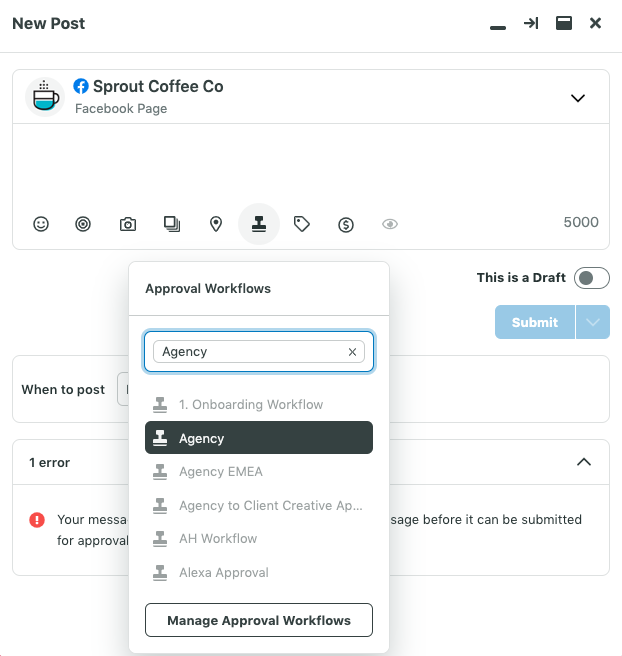
You can also build automated workflows into your scheduling process. If for example, your content creator has to run each post by the social media manager for approval before it goes live, there’s a Sprout workflow for that. As your team member schedules social posts in the Compose window, they can direct the post to the person or group that needs to review and approve content. This ensures that your social content is consistent and on-brand every single time.

Workflow_from_Compose.png

Not only does Sprout help streamline collaboration within social teams, it can also improve collaboration across departments.

These days, social media is one of the first places people turn for customer service. In the event that a community manager can’t address a comment or question that comes through the Smart Inbox, they can assign those messages to customer service representatives that have a seat in Sprout.

The same is true for potential leads that you want to alert your sales team about. If a person messages your brand on social media with purchase intent, you can assign a “Sales Lead” task to that message, so your sales team can capitalize on the opportunity.

An organized content plan, simplified approval processes and streamlined cross-departmental collaboration will help your social teams make a greater impact on your business. These are just some of the ways that a tool like Sprout Social can help your team work more efficiently without ever compromising quality.

Team building never stops

To build a strong team, start strong. As you invest in social staffing, give your new hires a clear mission and a thorough onboarding agenda. At Sprout, we outline important learning goals, dates, activities, deliverables and anything else we want new hires to be aware of within their first 30-60-90 days. Providing a plan can help ground a person and make them feel purposeful right from the get-go.

Even if you aren’t actively hiring more members, marketing leaders should remain committed to team building. Social media trends (and crises) emerge at light speed so quick huddles to kick off your day can spark inspiration, illuminate priorities and mitigate any risks your content might pose.

Team building is also important because burnout is a common issue among social media marketers. If your social marketers feel supported and heard, they’re more likely to speak up if they’re feeling stressed and overwhelmed by their work on social.

A dynamic social media marketing team can make a tremendous impact on business goals all the way from the top to the bottom of the funnel. We’ve seen it first-hand at Sprout. If you’re ready to expand and hire your dream social media team, use our free hiring manager toolkit to source, assess and secure top talent.

This post Bring it in: How to build an all-star social media team originally appeared on Sprout Social.


from Sprout Social https://ift.tt/2rmMTek
Do You Know You Can Buy Instagram Followers from SocialKingMaker.com?
Thursday, 29 October 2020

https://ift.tt/2Fvk3kT

amp_validated_url_content_placeholder1273811215

This post https://sproutsocial.com/insights/social-listening-for-consumer-brands/ originally appeared on Sprout Social.


from Sprout Social https://ift.tt/3mzvBYa
Do You Know You Can Buy Instagram Followers from SocialKingMaker.com?

What is local SEO and how to improve your local ranking

Word-of-mouth and local advertisements may be a great way to attract customers from your area. But online search can be equally impactful, if not more. In fact, Social Media Today reports that 97% of search engine users have searched online to find a local business. And 46% of all Google searches were seeking local information.

So if a business doesn’t rank in local search results, it could be missing out on valuable traffic and customers. In other words, local SEO could be the key to staying relevant and growing your business.

If you’re fairly new to local SEO, you might have a lot of questions and you probably won’t know where to start optimizing. This guide shows you some essential local SEO solutions and helps you understand the landscape better. So let’s jump right in.

What is local SEO and why do I need it?

To understand the local SEO definition, let’s first try to understand what local search means. Local search is when someone searches for businesses, products, services or any additional information relevant to one specific location. They could be searching for “concerts near me” to find an upcoming concert in their city or “best painting service in [location]” to find a painting service nearby.

an example of Google's local search results for best painting service in baton rouge

In other words, local search is more specific to a certain location compared to general Google searches. And Local SEO refers to the process of trying to optimize your online visibility to show up in those local search results.

Local SEO is crucial because it helps you:

  • Boost your online visibility
  • Bring in more foot traffic to your brick-and-mortar location
  • Attract more targeted traffic, which improves your chances of conversion
  • Enhance your credibility and build trust

Organic search results vs. local snack pack

One of the ways that local SEO enhances your online visibility is through the local snack pack results. Google sorts out local search results into three sections – sponsored, snack pack and organic. While the sponsored results appear prominently at the top of search results pages with the “Ad” or “Sponsored” label, they cost money.

Google's local SERP for painting service in seattle, and a red box highlighting the sponsored results

The snack pack results follow, appearing in a box that highlights the top three business listings related to that particular search. This shows up more prominently than organic local search results, which means there’s a better chance of visibility if you get featured in the snack pack.

And the best part is, not every local search page features sponsored results. So your business could sit prominently at the top of the search results page, as you can see below.

An example of Google's local snack pack results for shoe stores in las vegas. These are the listings that appear under the map.

The organic results are further down, below the local snack pack results. So even if you rank on the first page of local search results, you might not show up as prominently as the businesses that manage to get featured in snack pack results.

An example of a Google SERP highlighting organic local results

The goal of your local SEO strategy should be to rank on the first page of organic local searches as well as in your local snack pack. This ensures optimum visibility and improves your chances of attracting targeted traffic.

6 ways to boost your local SEO strategy

Now let’s move on to the most important part – how to boost your local SEO strategy and improve your local search ranking. There are plenty of aspects to this, so let’s focus on the most critical ones:

1. Claim and optimize your GMB listing

GMB or Google My Business is essentially the most critical part of your local SEO strategy. This tool from Google allows you to create free business listings. And according to Moz, it’s one of the top factors that Google will consider when ranking businesses in organic local search and snack pack results.

To start, go to the Google My Business website to claim or create your listing.

Graphic from Google's page to claim your GMB listing

You need to provide the following details for your GMB listing:

  • Your full and correct business name
  • Your physical store/office address
  • Your exact location on a map
  • Your business category
  • Your phone number and website (if applicable)

Once your listing goes live, you’ll need to verify it usually through a phone call or via postcard. Here’s how to optimize Google My Business after verification:

  • Upload photos of your business. This could be photos of the inside your store/office or even around the premises.
  • Provide your business hours.
  • Provide additional categories that may be relevant to your business.
  • Provide additional phone numbers if available.

You can further optimize your GMB profile by sharing business updates and fresh content regularly. And Sprout Social makes that easier with a new feature to post directly to your GMB profile. Make the most of the Sprout GMB feature to update your customers with what’s new and share details about upcoming events. This helps you connect with your customers on a deeper level in addition to boosting your visibility in local searches.

2. Keep mobile in mind

With smartphones now being a part of our daily lives, it’s only natural that a lot of people will be using their phones to search for local information and businesses. Uberall commissioned a study, which found that 82% of respondents had used their mobile devices to conduct a “near me” search. This proves just how much people are using their phones for local search.

So it’s crucial that you cater to these searchers by optimizing your website for mobile screens. Create a mobile-friendly website so mobile visitors have no trouble navigating it or finding the information they need.

Don’t forget to add click-to-call buttons on your site and on your GMB listing. This could make a huge difference because 60% of mobile users have contacted a business directly from search results.

3. Collect plenty of customer reviews

According to the Moz study cited earlier, review signals also play a critical role in your local search and snack pack ranking. So having plenty of authentic reviews, particularly positive ones, could work wonders to boost your visibility in local search in addition to enhancing your reputation. That means you need to work towards collecting more authentic customer reviews for your business.

Maintain your focus on sites where Google would expect businesses to have reviews. So in addition to your website and your GMB listing, it’ll also collect reviews from consumer directories and social media. That means you should focus on collecting reviews for Facebook, Yelp, Thumbtack, Foursquare, Angie’s List, etc. depending on which ones are relevant to your business.

4. Focus on local link building

According to Moz, link signals such as linking domain authority and quantity are among the top factors that influence your ranking in local searches and snack pack results. So just like with regular SEO, local SEO also requires link building to boost your link profile. However, the linking domains should be more relevant to your target location.

That means you should target authority websites in your target region. This could be anything from licensing bureaus and trade associations to the Chamber of Commerce or even .edu sites.

Partnerships, scholarships, guest posting, etc. could be excellent ways to gain valuable backlinks from local sites. For example, you can see the Connecticut College website linking back to several local establishments from its “Attractions” page.

attractions page on the Connecticut College website that links out to local establishments

5. Ensure NAP/citation consistency

Moz also found that Google considers citation signals such as citation volume and NAP (name, address, phone number) consistency in local search results. This means your information should be on major citation websites; besides GMB, think Bing Maps, Yelp and Facebook. Focus on directories that have higher domain authority than on smaller listing directories.

More importantly, make sure your business NAP is consistent across all platforms and websites. Look out for any misspellings, address and phone number discrepancies, duplicate listings and resolve them to improve your local SEO.

6. Make the most of social listening

Social listening may have primarily served as a source for marketing insights, but it has many benefits beyond that. It could even help fuel your local SEO strategy if you know which insights to look out for and how to make the most of them.

Use social listening to find out what people in your target location are saying – whether it’s about your business or in general. You could even use it to collect information about audience interests, priorities and so on. Then make the most of these insights to find out how you can make changes to your strategy or even to your products and services.

For instance, you might have noticed people complaining about the lack of outdoor seating at your cafΓ©. Maybe it’s time to introduce it to appeal to an even bigger audience. You can then optimize your GMB SEO by sharing updates about your new seating arrangement, for instance.

Or maybe you’ve noticed people wishing your hair salon also provided manicure services. You could expand your service offering and share this update on your GMB profile.

Additionally, your social listening efforts could also help you understand what types of local content your target audience might be looking for. You could then build a robust local content strategy to fit those needs. Plus, you might even be able to uncover long-tail keywords to use in your content optimization strategy.

Ready to get local?

These are the essentials on how to take your local SEO efforts to the next level. Keep in mind that your local SEO efforts can span across various locations. And you can even apply these ideas in your SEO for multiple locations if you’re targeting more than one area. So make the most of them to enhance your online visibility in local searches and grow your business.

For more valuable insights that could help you fuel business growth, don’t forget to download your copy of the Sprout Social 2020 Index.

This post What is local SEO and how to improve your local ranking originally appeared on Sprout Social.


from Sprout Social https://ift.tt/3mAqFlO
Do You Know You Can Buy Instagram Followers from SocialKingMaker.com?

Wednesday, 28 October 2020

For Halloween 2020, old traditions get a new look to accommodate the pandemic

Like most big events this year, Halloween 2020 is going to look different from years past. As COVID-19 cases continue to rise across the country, traditional activities like trick-or-treating are on hold and parties are strongly discouraged. One study even found more than 75% of consumers say the pandemic has impacted their celebrations, leaving some people asking, “Is Halloween 2020 cancelled?”

As it turns out, the answer is no. Because if there’s one thing we’ve learned from this year, it’s that people are willing and able to adapt to make the best of the situation. In Chicago, a bar is launching a drive-thru haunted house while streaming service Hulu is hosting a similar entertainment experience in Los Angeles. And to make up for trick-or-treating, the Mars Wrigley company created a virtual trick-or-treating app for consumers all over the country to use.

In other words, Halloween activities may look unusual this year, but the spirit of Halloween remains strong. Using Sprout’s Social Listening Platform, we looked at recent conversations around Halloween to learn how people are pivoting and adjusting their traditional spooky activities. We analyzed over 13 million messages across Twitter from October 1 to 27 to learn more about how people are entertaining themselves for Halloween in 2020.

Surprise! It’s spooky season all month long

Whether because of the impending election or the ongoing pandemic, the weeks leading up to the October holiday appear to have caught some people off guard. The word “realize,” for example, showed up in over 41,000 messages about Halloween activities as people took to social to share they hadn’t indulged in as many spooky activities this year.

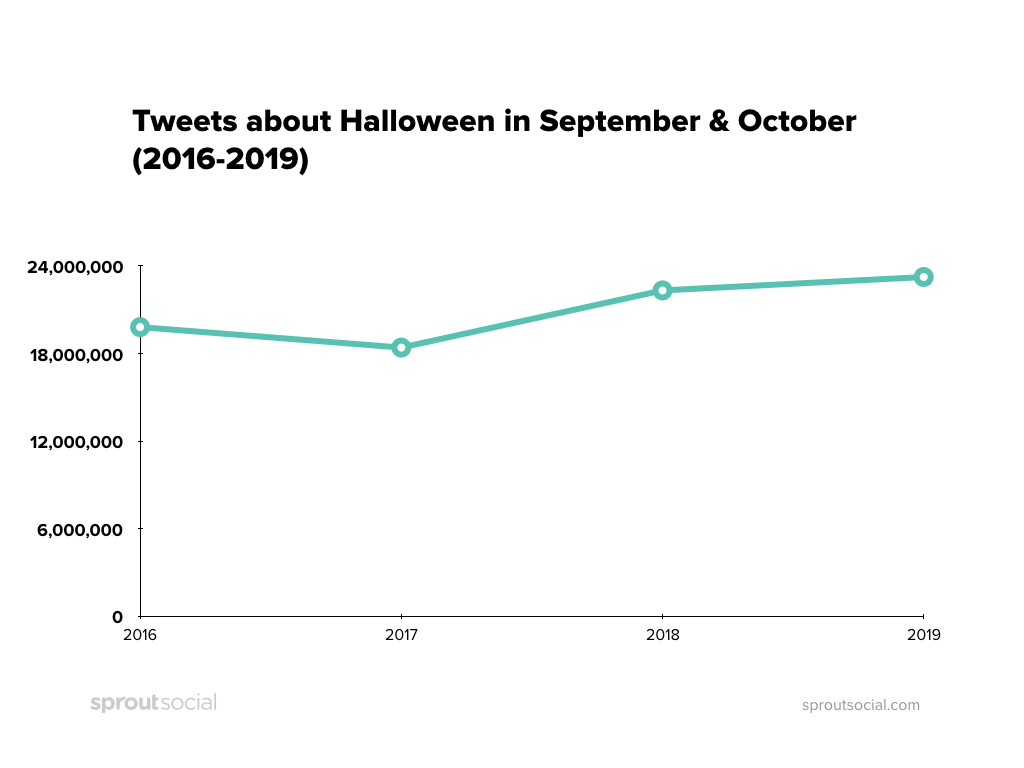
Historically, Halloween is a popular topic of conversation all throughout September and October. In 2016, there were over 19 million mentions of Halloween or #Halloween on Twitter and that number jumped to over 23 million in 2019. This year, from September 1 to October 27, , we’ve recorded more than 16 million mentions of Halloween or #Halloween—a 27% increase compared to the same time last year.

The volume of Halloween conversations varies from location to location. When we compare the volume of messages to the region’s population, Washington D.C. had the highest volume rate followed by Nevada and New Jersey. To find this data, we broke down the volume of Halloween mentions by state and divided that number by the state population based on estimates from the U.S. Census.

  1. Washington, D.C.
  2. Nevada
  3. New Jersey
  4. Oregon
  5. California

Interestingly, the highest volume of Halloween conversation occurs in regions where COVID cases are steadily increasing but are not experiencing unchecked community spread (more than 25 daily new cases per 100,000 people). As the holiday nears, officials like governors and mayors are taking to Twitter to share advice on how to celebrate accordingly. As social chatter around activities began picking up, more than 213,000 messages referenced safety, COVID and related terms as people asked for recommendations on how to celebrate safely.

Other annual traditions are receiving a makeover to accommodate the pandemic. In D.C., for example, the National Air and Space Museum pivoted away from their signature in-person event to an at-home pumpkin carving contest. In Portland, Oregon, drive-in horror experiences are a safe and socially distant option for thrill seekers.

On the other hand, the annual trick-or-treating festivities at the Nevada governor’s mansion were canceled as cases began to spike in the state. And universities, like San Diego State University, are issuing warnings to students to stay home during Halloween weekend to prevent the spread.

Classic traditions with a socially-distant twist

As far as 2020 Halloween ideas go, people are still thinking of ways to make trick-or-treating a reality. Nearly 429,000 messages about Halloween referenced trick-or-treating as people flex their creativity over how they get their candy fix this year. James Breakwell, author of Exploding Unicorns, shared how his kids hosted their own at-home Halloween 2020 complete with trick-or-treating.

Conversations about virtual activities and parties are also increasing steadily online, with over 8,400 messages referencing virtual or Zoom activities. Of those, over 7,500 messages reference virtual parties or Zoom parties specifically. Author R.L. Stine, for example, is hosting a virtual Halloween party for children on the 31st while the “Top Gun” movie account shared GIPHY backdrops to complete any Zoom party.

Finally, movies play a big role in keeping the Halloween spirit alive. In addition to virtual watch parties and drive-in screenings, Halloween fans can expect exclusive new content based on their favorite October classics. The New York Restoration Project, for example, is hosting a one-time broadcast featuring the Sanderson sisters from “Hocus Pocus,” a move sure to delight fans of the cult classic film.

Gaming is all-in on Halloween

One industry that was ready to tackle all the challenges posed by the pandemic? Gaming. A closer look at the Halloween 2020 social conversation revealed a healthy amount of chatter around gaming and the exclusive content offered in October.

Surprisingly, the most talked about video game isn’t available in North America at all. Disney’s Twisted Wonderland, a Japanese mobile game, dominated a good portion of the gaming conversation with more than 304,000 messages. Taking full advantage of the Halloween season, the mobile game launched a series of days-long campaigns, or ‘missions,’ to keep gamers engaged all October long.

Additionally, Overwatch fans were treated to new Halloween-themed challenges, skins and loot boxes to help celebrate the October holiday from the comforts of their home. Listening data shows a spike in conversations around this event following the initial announcement on October 10, and currently there are more than 70,000 messages mentioning Overwatch’s Halloween activities.

Not to be outdone, the ever-popular Call of Duty also joined in on the spooky celebration. The video game dropped its own Halloween event, the Haunting of Verdansk, on October 20 to the delight of Warzone fans all over the world. From October 1-27, conversations around Call of Duty, Warzone and other related terms increased 1,732%, garnering more than 29,000 messages.

The haunting must go on

Rather than let the pandemic suck all the fun out of October, people and brands are finding new ways to keep the spirit of Halloween alive. From Zoom parties to month-long virtual events to drive-in screenings, there are a number of creative and safe ways to celebrate the spooky season. And while some festivities may only be temporary, like virtual trick-or-treating, don’t be surprised if we see some new traditions stick around for the long run.

Social listening can help you uncover how people are pivoting in times of pandemic and what activities they’re turning to during the holiday season. If you’re interested in learning what other insights can come from social listening, check out our article on listening for consumer brands or contact us for a free Sprout listening demo today.

This post For Halloween 2020, old traditions get a new look to accommodate the pandemic originally appeared on Sprout Social.


from Sprout Social https://ift.tt/3e8WNtQ
Do You Know You Can Buy Instagram Followers from SocialKingMaker.com?